Melody
A melody is a collection of musical tones that are grouped together as a single entity. Most compositions consist of multiple melodies working in conjunction with one another.
Melody Characteristics
Melodic line - a succession of notes forming a distinctive sequence. It is further characterized by the melodic focal point the music builds to with the line of high or low notes tending to create an arc-shaped or V-shaped melodic contour.
Conjunct or Stepwise Motion - the movement of the melodic line in a scale pattern, where notes only move by a whole tone or a half tone
Disjunct or Leap Motion - the movement of the melodic line that “leaps” in intervals of a third or more.
Melodic Theme - it is the subject of the composition, usually a recognized melody, upon which part or all of the composition is based.
Phrase - a substantial musical thought, which ends with a musical punctuation called a cadence. Phrases are created in music through an interaction of melody, harmony, and rhythm. It is the melodic lines that most often identify a musical phrase.
Figure - the shortest phrase in music; a short succession of notes, often recurring.
Motif - a short music phrase (but longer than a figure) that possesses some aspect of the composition's thematic identity.
Antecedent Phrase - The first section of the phrase. The end of an antecedent phrase often ends on the dominant pitch of the scale and the harmonic cadence is I-V. The music sounds interrupted and unfinished, leaving the listener unsatisfied, unresolved, and demanding more.
Consequent Phrase - The second section of the phrase most often ends on the tonic pitch of the scale (or the tonal center) and the harmonic cadence is V-I. This leads to a completed musical thought or resting place and leaves the listener satisfied.
Cadences
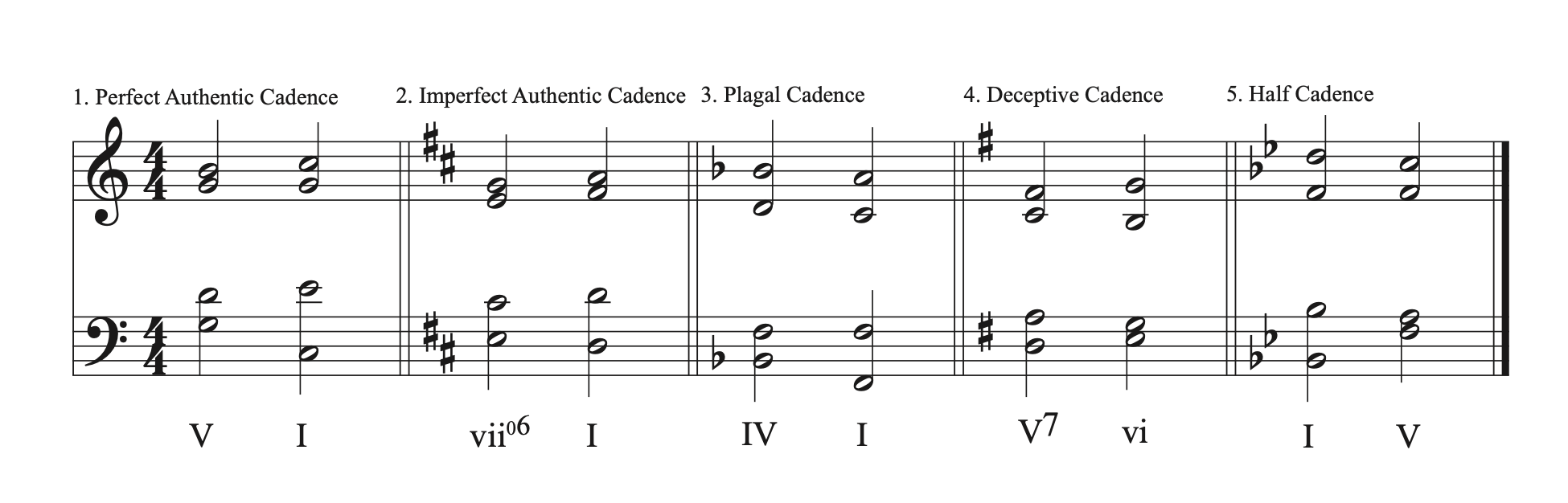
A cadence identifies the ending of a musical phrase. If it is an antecedent phrase, it usually ends with a Half Cadence or a Deceptive Cadence. If it is a consequent phrase, it usually ends with a Plagal Cadence or an Authentic Cadence.
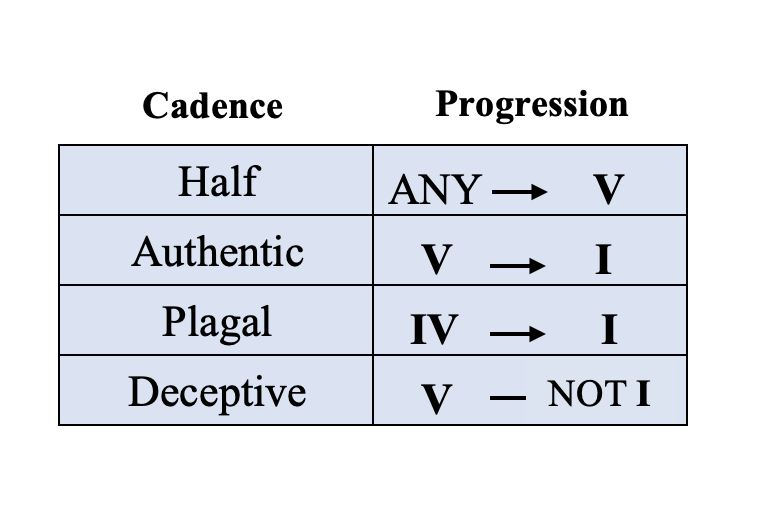
Authentic Cadence (V, I) - where the dominant triad (based on the 5th tone of the scale) is followed by the tonic triad (based on the 1st tone of the scale). This is often referred to as a Perfect Cadence or a Perfect Authentic Cadence.
Plagal Cadence (IV, I) - where the subdominant triad (based on the 4th tone of the scale) is followed by the tonic triad (based on the 1st scale degree). The plagal cadence is often referred to as the “Amen” cadence.
Half Cadence (…, V) - any cadence that ends on the dominant triad (based on the 5th tone of the scale).
Deceptive Cadence (V, ….) - a progression in which the dominant triad resolves to a chord other than the tonic chord.